

Why Your Home Feels Humid Even With the AC Running


If you’ve noticed that your home feels humid even with the AC running, you’re not imagining it — and the heat alone isn’t always the explanation.
Your air conditioner is designed to do two things: cool the air and remove moisture from it.
In Hampton Roads, where outdoor humidity regularly hits 80–90% during summer and early fall, that second job is just as important as the first.
When a system is working correctly, indoor humidity should stay between 40–60%.
If it feels muggy inside despite the AC running, something is interfering with that process.
Here are the most common causes.
Why Your Home Feels Humid Even with AC Running : It May Not Be Removing Humidity
Low refrigerant. Refrigerant is what allows your system to absorb heat and moisture from indoor air. When levels drop — usually from a slow leak — the system’s ability to dehumidify drops with it. The air may feel cooler but still heavy, because the system is moving some heat but not enough moisture. If your home has felt progressively more humid over the past season, low refrigerant is worth checking.
An oversized system. This one surprises homeowners. A system that’s too large for the space cools the air too quickly and shuts off before it has run long enough to pull meaningful moisture out. The result is a home that reaches temperature but stays humid. Proper equipment sizing matters — and it’s one of the most common mistakes made during system replacements when contractors don’t do a proper load calculation.
A dirty evaporator coil. The evaporator coil is where moisture is pulled from the air. When it’s coated in dust and debris, it can’t do this job effectively. Restricted airflow from a clogged filter compounds the problem. Regular maintenance — filter changes and annual coil cleaning — is the main defense.

Aging equipment. Older systems lose dehumidification capacity as components wear. A system that kept your home perfectly comfortable at 10 years old may struggle at 14 or 15. If humidity problems have developed gradually over several seasons, age may be a factor.
Duct leaks. In homes with ductwork in unconditioned spaces — attics, crawl spaces — gaps or leaks can pull humid outside air into the system before it can be conditioned. The conditioned air you paid to cool and dehumidify gets diluted by outdoor humidity before it even reaches your living space.
What to Try Before Calling
A few simple checks are worth doing first.
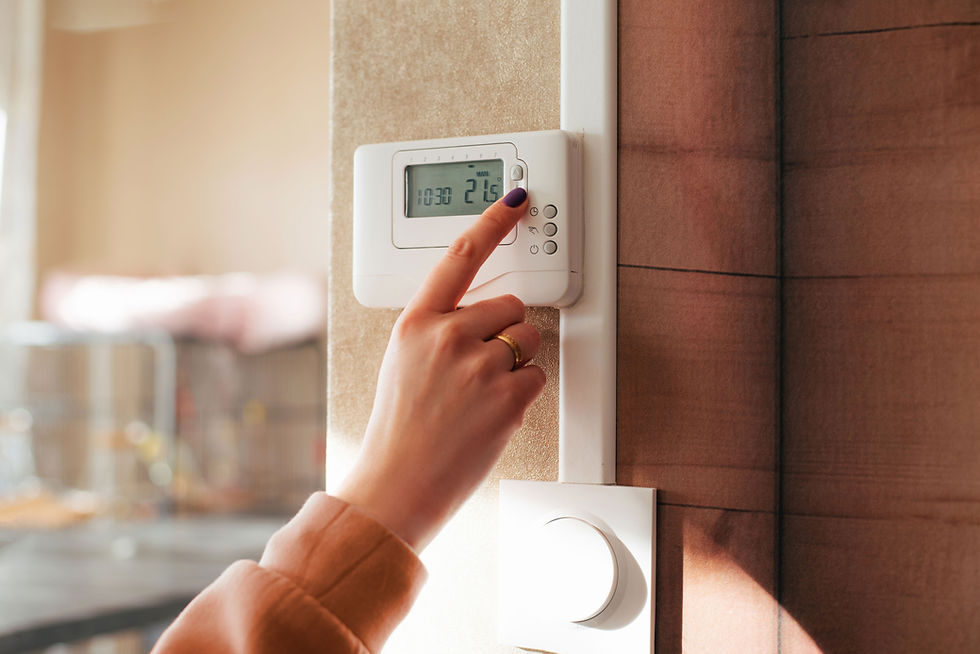
Make sure your thermostat fan is set to AUTO rather than ON. When the fan runs continuously, it keeps blowing air even when the system isn’t actively cooling — which means moisture that collected on the evaporator coil gets blown back into the room.
AUTO mode lets the coil drain between cycles.
Replace your filter if it’s overdue. Restricted airflow reduces the system’s ability to remove moisture just as much as it reduces cooling capacity.
If your thermostat has a dehumidifier setting or a humidity control option, make sure it’s active and set appropriately.
When to Call
If those basics are in order and your home is still humid, it’s time for a professional look.
Most of the causes above — low refrigerant, dirty coils, duct leaks — are straightforward to diagnose and address when caught early. Left alone, they tend to get worse and more expensive.
In Hampton Roads, where humidity is a genuine quality-of-life issue for most of the year, a system that isn’t dehumidifying properly isn’t fully doing its job. It’s worth addressing.
Comfort Technology serves Hampton, Newport News, Chesapeake, Norfolk, Williamsburg, and the surrounding Peninsula and Hampton Roads area.
Call us at 757-599-9700 or schedule online at comforttechnologyinc.com.


Comments